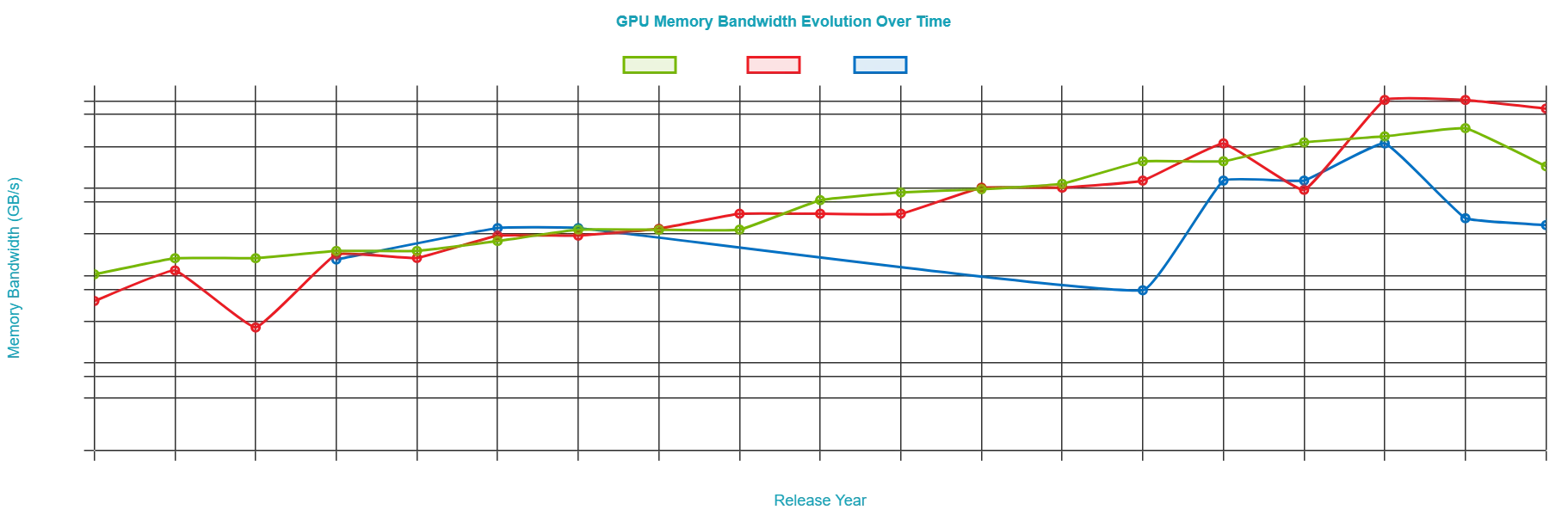
GPU Memory Bandwidth Evolution (2007–2025)
At Axiom Gaming, we track and analyze the hardware trends that shape the future of gaming, content creation, and artificial intelligence. One of the clearest indicators of GPU progress is memory bandwidth - the rate at which data moves between GPU cores and memory.
This report examines 1,727 GPUs released between 2007 and 2025, highlighting how memory bandwidth has evolved, where it stands today, and where it's headed.
Defining Memory Bandwidth
Memory bandwidth is measured in gigabytes per second (GB/s).
How to Calculate Memory Bandwidth
- Step 1: Identify memory frequency (MHz) and bus width (bits).
- Step 2: Apply formula: Frequency × Bus Width × 2 ÷ 8.
- Step 3: Result = Memory Bandwidth in GB/s.
Bandwidth dictates whether GPU cores remain fully utilized or stall waiting for data.
- For gamers → impacts smooth frame rates at 4K and 8K resolutions.
- For professionals/researchers → governs how quickly GPUs can process datasets, simulations, and AI workloads.
Historical Growth: 2007–2025
Legacy Era (2007–2015)
- Bandwidth Range: ~32–512 GB/s
- GPUs relied on GDDR3 and GDDR5, marking the transition from early HD gaming to 1080p/1440p workloads.
- Example cards: NVIDIA GTX 580 (192.4 GB/s), Radeon R9 Fury.
Modern Era (2016–2019)
- Bandwidth Range: ~107.1–819 GB/s
- Key GPUs: Tesla V100 SXM2 16 GB (320 GB/s), Radeon Instinct MI50 (616 GB/s).
Recent Era (2020–2025)
- Bandwidth Range: ~68.3 GB/s – 10,300 GB/s
- GDDR6X pushed consumer GPUs close to 900 GB/s.
- HBM2E & HBM3 in datacenter/AI GPUs broke the 1 TB/s barrier.
- Current leader: AMD Radeon Instinct MI300A (10,300 GB/s).
Efficiency: Bandwidth per Watt
Raw performance tells only half the story. Bandwidth per watt is now a critical efficiency metric.
- Mainstream Gaming GPUs → 2–3 GB/s per watt.
- HBM3 Accelerators → 16+ GB/s per watt.
This underscores how power efficiency is now as important as raw speed.
Current Leaders
- Consumer Segment → High-end GDDR6X gaming GPUs up to 900 GB/s.
- Enterprise Segment → HBM3-based accelerators surpassing 10 TB/s, essential for AI model training and HPC workloads.
The Road Ahead
- HBM3E & HBM4 in development.
- Projected bandwidth: 15–20 TB/s.
- Designed for trillion-parameter AI models and next-gen HPC systems.
What This Means for Gamers & Builders
- Gamers → Better 4K/8K, ray tracing, VR frame rates.
- Content Creators → Faster rendering/encoding.
- AI Researchers → Bandwidth is now a core bottleneck; HBM-equipped GPUs are becoming mandatory.
Conclusion
From 32 GB/s in 2007 to 10,300 GB/s in 2025, GPU memory bandwidth has grown 500x in under two decades.
This trajectory reflects:
- Rising complexity of modern games.
- Professional reliance on GPUs for rendering and simulations.
- GPUs’ new role as the backbone of AI, HPC, and immersive computing.